The Revolution of Computer Vision Object Detection in Damage Assessment
The insurance and automotive industries are undergoing a massive digital transformation. At the heart of this change is computer vision object detection, a technology that allows machines to "see" and interpret visual data just like humans, but much faster.
I. Overview: The Shift to Visual Intelligence
Computer vision technology is a branch of AI and data science that trains computers to identify and process objects in images or videos. This classification technique helps the systems to assess the damage by analysing the image. By leveraging deep learning, these systems can now automatically detect, classify, and even quantify damage.
In the current landscape, this technology is very relevant because it moves us away from time-consuming and paper-based workflows. In case of a car accident or property damage, the ability to process claims instantly using AI image detection is no longer a luxury—it is an industry standard for staying competitive in 2026.
II. Manual vs. Automated Damage Detection
For decades, we relied on manual inspections. While they worked, they were far from perfect.
Challenges in Manual Damage Assessments
Subjectivity: Different human adjusters often give different repair estimates for the same dent. It is very important for the insurance aspects as the insurance cover for the damage is absurd in most cases.
Time Consumption: It can take days for an appraiser to visit a site and write a report.
High Costs: Sending experts to various locations involves significant travel and labour expenses.
- Inconsistency: Human error, fatigue, and lack of experience can lead to missed damage.
Computer vision AI eliminates these bottlenecks by providing a consistent, 24/7 automated alternative.
III. Benefits and Limitations
Switching to an AI image detector offers several measurable advantages, but it also has hurdles to clear. Someof the benefits are as follows -
The Benefits of AI Detectors
Speed and Efficiency: Systems can analyse AI-generated images and produce reports in seconds.
Accuracy and Consistency: Deep learning for computer vision provides standardised results, reducing disputes between insurers and clients.
Lower Cost: Automating the first level of inspection significantly lowers operational cost.
Faster Claim Responses: Policyholders in the vehicle insurance sector get their settlements much quicker via mobile apps. Where the manual process takes 24-48 hours to complete, the automated claim settlement process takes 30-60 seconds.
Machine Learning and Fraud Detection: AI algorithms can spot "deepfake" images or reused photos from previous claims. This efficient fraud detection generally saves the company a significant amount of money.
The Limitations
Environmental Factors: Poor lighting, heavy rain, or glare can sometimes confuse AI detectors.
Lack of human interaction: In cases of disputes during the AI damage assessment process, people sometimes require a human representative for assistance. This process is somewhat troublesome in some cases.
Subtle Damage: Very tiny scratches or "micro-damages" might still require a human AI engineer to verify.
- Hardware Dependence: High-quality AI image processing requires powerful GPUs and stable internet connections for cloud-based models. This occasionally increases costs for the company in the initial setup
IV. Types of damage and assessment techniques
In this section, we will break down how computer vision technology and automated damage assessments actually process these images. By using deep learning for computer vision, the system follows a specific technical workflow to turn a simple photo into a professional repair estimate. With this, 3 types of crack and the assessment strategies have been provided.
The Bullseye Crack
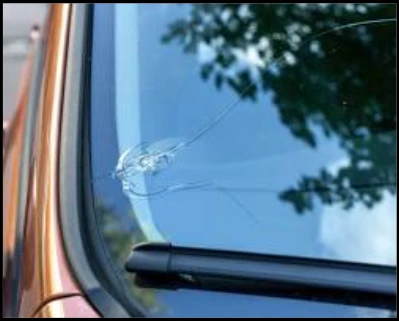
This is a circular impact mark with a dark centre. Computer vision object detection looks for concentric circles. It is relatively easier for the AI to "segment" because of its distinct round shape.
(Source: Sucuri.net)
When a user uploads an image of a bullseye crack, the AI detector begins a process called "Feature Extraction."
How it works: The convolutional neural network (CNN) identifies the dark, circular centre and the surrounding halos. As this crack has a very specific geometry, the AI algorithms can easily differentiate it from a simple dirt smudge.
The Assessment: The system calculates the diameter of the "cone." In the insurance AI world, if a bullseye is smaller than a “one-inch coin”, the automated damage assessment software will flag it as "repairable." If it’s larger or in the direct line of sight of the driver, the system automatically updates the claim to a "full replacement."
The Star Crack
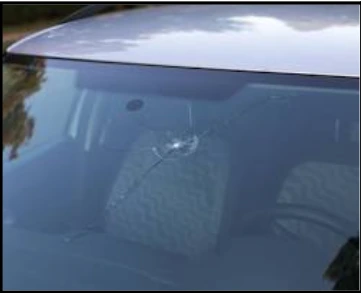
This pattern features several small cracks radiating from a central point. AI algorithms use edge detection to follow each "arm" of the star to measure its total diameter, which determines if the windshield is still structurally sound.
(Source: Sucuri.net)
The star crack is more complex for computer vision object detection because of its radiating legs.
How it works: The AI image processing engine uses "Edge Detection" to trace every individual fracture line extending from the centre. It uses AI and machine learning to determine the "stability" of the crack. If the "legs" of the star are too long, they are likely to spread due to vehicle vibration.
The Assessment: The AI technology measures the total span of the star. If the radiating cracks are too close to the edge of the windshield, the AI image detector knows the structural integrity is compromised. It then uses computer vision AI to cross-reference a parts database and find the exact cost for a new windshield for that specific car model.
Long Hairline Crack
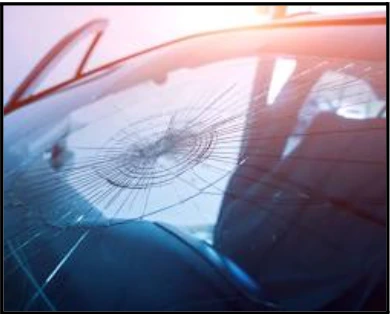
Unlike the localised impacts above, this is a single, long line that often stretches across the glass. Deep learning for computer vision is particularly good at distinguishing these from simple hair or debris by analysing how the crack refracts light.
(Source: Sucuri.net)
Hairline cracks are a challenge for AI detectors because they can be confused with reflections of power lines or wires.
How it works: To solve this, the AI engineer trains the model using "Texture Analysis." A real crack has a "jagged" pixel signature at a microscopic level, whereas a reflection is smooth. The deep learning model looks for the "refraction" of light, the way the crack splits light into a rainbow or a bright white line.
The Assessment: The computer vision technology tracks the path of the crack. If a crack is longer than 6 inches, the automated damage assessment logic usually triggers an "unsafe to drive" alert. A large language model then processes this information to generate a human-readable safety warning for the policyholder.
V. Types of Segmentation
To provide a comprehensive view of computer vision technology in damage assessment, we must look at how the AI engineer selects the right model for the job. Below are the detailed analyses for each segmentation type and a comparison of their capabilities.
1. Semantic Segmentation
Semantic segmentation is a foundational AI image processing technique that assigns a class label to every pixel. It considers every object looking similar as same entity. In the context of insurance AI, it treats all objects of the same category as a single mass. For example, if a car has multiple dents, a semantic segmentation model labels all affected pixels as "damage" without distinguishing between individual impact points. This is highly effective for calculating the total square footage of a damaged area to estimate paint and material costs in AI and data science workflows.
2. Instance Segmentation
Instance segmentation goes a step further. It identifies and distinguishes every individual object instance. Using deep learning for computer vision, this method treats each scratch or dent as a unique entity, even if they belong to the same class. An AI image detector using instance segmentation can separate two overlapping dents and assign them unique IDs. This computer vision technology is critical for machine learning and fraud detection, as it helps adjusters verify if specific damages match the reported accident's physics.
3. Panoptic Segmentation
Panoptic segmentation is the most advanced AI technology, serving as a "unified" approach that combines both semantic and instance data. It uses complex AI algorithms to map out "stuff" (uncountable regions like the road or sky) and "things" (countable objects like cars or specific cracks). By providing a holistic view, it gives the AI detector a full environmental context. This is one of the best computer vision examples for autonomous claims, as it understands the damage in relation to the entire scene.

(Source: Infotube)
Comparison Table: Segmentation Models in Damage Assessment
Feature | Semantic Segmentation | Instance Segmentation | Panoptic Segmentation |
Goal | Label pixels by class category | Detect and separate individual objects | Provide complete scene understanding |
Granularity | Class-level (All dents = 1 mask) | Object-level (Dent 1, Dent 2, etc.) | Pixel-level (Class + Instance ID) |
Key Keyword | Image segmentation | AI image detection | AI image processing |
Best For | Measuring total surface area | Identifying separate impact points | Contextual accident reconstruction |
Complexity | Moderate | High | Very High |
FAQ
1. What is computer vision object detection in damage assessment?
Computer vision object detection is an AI-based technology that enables machines to analyse images or videos and identify damaged areas automatically. In the insurance and automotive industries, it helps detect dents, cracks, or scratches from photos and provides quick damage evaluation without manual inspection.
2. How does AI detect vehicle damage from images?
AI systems use deep learning models such as Convolutional Neural Networks (CNNs) to analyse visual patterns in images. The model extracts features such as edges, textures, and shapes to identify different types of damage, including bullseye, star, and hairline cracks.
3. What are the main benefits of using AI for damage assessment?
AI-powered damage detection offers several advantages, including faster claim processing, improved accuracy, reduced operational costs, and consistent evaluation results. It also helps insurance companies detect fraud by identifying reused or manipulated images.
4. What are the limitations of computer vision in damage detection?
Although powerful, AI damage detection systems may struggle in poor lighting conditions, heavy rain, or when images are blurry. Very small scratches or micro-damages may also require manual verification by human experts.
5. What is the difference between semantic, instance, and panoptic segmentation?
Semantic segmentation labels every pixel belonging to a category (e.g., all damage areas). Instance segmentation identifies each damage separately (e.g., Dent 1, Dent 2). Panoptic segmentation combines both approaches to provide a full scene understanding with object-level and background information.